ServicesGutters
Gutters in La Rue, Ohio
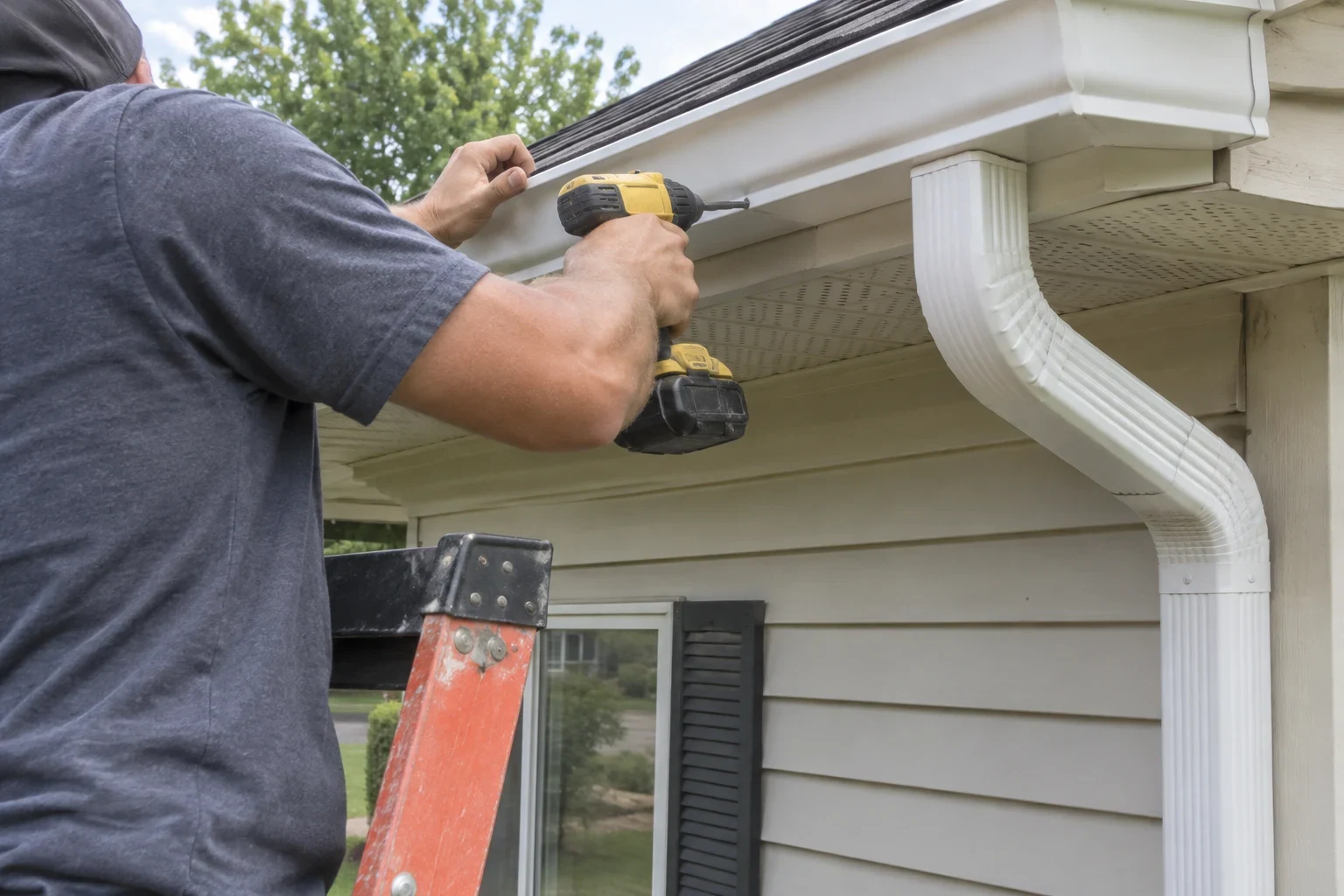
We install and repair one-piece aluminum gutters sized to the roof above them, pitched to drain and screwed into solid fascia. We check your system before it overflows or pulls loose, so you can schedule and budget the work on your terms instead of after a wet basement.
What a Gutter System Actually Has to Do
Rain that leaves your shingles needs a planned destination. A gutter that works collects it along the eave and moves it somewhere it cannot saturate the foundation, the fascia or the wall behind them. When gutters fail, we usually find one of three causes. The trough is undersized for the amount of roof shedding into it, the run lacks a steady fall and holds water in dips, or the fasteners have worked loose in fascia that is beginning to rot.
Ohio winters bring a fourth. Standing water in a gutter turns to ice, and that extra weight levers old spike-and-ferrule fasteners out of the board. A sagging run is much easier to deal with in October than after a February thaw.
Our gutter work covers new installation, section repairs, downspout rerouting and guards. If the board behind a gutter is soft, we will recommend our soffit and fascia service first, so the new gutter is fastened to sound wood.
What Our Gutter Work Includes
- One-piece aluminum gutters
- Each gutter is formed from a coil of aluminum on site and cut to the length of the run. Seams appear only at corners and end caps, so there are far fewer sealed joints that can open and leak.
- Sizing by roof area
- We measure each roof plane draining into each gutter. Plenty of homes do fine with a 5-inch K-style, but long or steep slopes often need a 6-inch gutter with 3x4 downspouts to keep up in a downpour.
- Hidden hangers and correct pitch
- We set hangers roughly every two feet and screw them into the fascia, which holds far better than spikes or nails. Every run slopes slightly and evenly to its outlet so water doesn't pool and freeze.
- Downspouts that discharge away
- Outlets go where the water can be carried well away from the foundation, and we add extensions or splash blocks so it doesn't dump against the wall.
- Drip edge and roof edge check
- Water coming off the shingles should fall into the gutter, not run down behind it. We make sure drip edge or a gutter apron is in place and point out any roof edge trouble we see.
- Guards when they make sense
- If trees hang over your home, we can add guards and tell you which style suits the leaves, needles or seeds that land on your roof.
Signs Your Gutters Need Attention
Water spilling over during steady rain
Rain pouring over the front lip means the gutter is blocked, undersized for the roof above it, or lacking enough downspouts.
Runs that droop or pull loose
A gutter that dips or has come away from the house typically has loose fasteners or decaying fascia behind it, and ice adds to the damage every winter.
Leaks at joints and corners
On older homes, sectional gutters drip where the pieces meet. Repeated resealing just postpones the problem, since those joints keep separating.
Streaked siding or flaking trim
Dark lines running down the siding or paint peeling off the trim show where water is escaping over or behind the gutter.
Damp basement or washed-out beds
Mulch carried off below a downspout or a wet basement wall beside it shows the runoff is landing too near the foundation.
How a Gutter Job Runs
- 1
Walk the system with you
We look at every run, downspout and the fascia behind them, and take photos of what we find. You get a clear answer on whether repair or replacement makes sense.
- 2
Written plan and estimate
Your estimate lists footage, gutter size, downspout count and any fascia work as separate lines. That lets you schedule it now or budget it for a later season.
- 3
Remove and inspect
On install day we take down the old gutters and check the fascia once it is exposed. If we find rot, we show you before anything else goes up.
- 4
Form, hang and test
We form each continuous run on site, hang it on hidden hangers and run water through it to confirm it drains. Then we clean up old metal, fasteners and debris.
What Moves the Cost of Gutters
A gutter price is mostly two things: how much metal goes up and how much work it takes to get it there. We build each estimate from measurements taken at your home, so the figure fits your house rather than a neighborhood average. Seeing these factors early lets you set money aside before a sagging run turns into a rush job.
- Linear footage and stories
- The total length of eave sets the material order. A second or third story means taller ladders, more setup and slower handling of each run.
- Gutter profile and outlets
- Stepping up to a 6-inch profile, or adding extra outlets with 3x4 downspouts, costs more in material. It is also frequently the fix for a side of the house that overflows every storm.
- Fascia condition
- Soft or rotted boards must be replaced before new gutters can be fastened to them. This is the hidden cost we see most often, so we probe the fascia before we write the number.
- Guards and extras
- Guards, tie-ins to underground drains and longer downspout extensions each appear as a separate line, so you can decide which ones earn their keep.
Gutter Questions We Hear Often
Something not covered here? (740) 913-4252
Is it smart to put on new gutters when the roof is replaced?
In many cases, yes. The roof crew is already working along the edge where gutters hang, and doing new drip edge and gutters in one job keeps the whole path from shingle to downspout matched up. When your current gutters are fairly recent and sound, we can usually leave them in place.
Which size fits my house, 5-inch or 6-inch?
That comes down to the amount of roof feeding each run and its pitch. A big, steep slope can push water down faster than a 5-inch gutter handles in a hard storm. We measure each side of the house and recommend a size for every one.
Will you repair a single damaged section?
Yes. We reseal leaking corners, rehang runs that sag and swap out dented or cracked pieces. When an aging system is leaking at joint after joint, we say so plainly, because at that point repairs stop being worth what they cost.
Will gutter guards end gutter cleaning for good?
No guard removes all maintenance. A well-made one blocks leaves and twigs, yet fine material such as shingle granules and seed pods can still collect on it. Under overhanging trees, though, guards cut cleaning down by a wide margin.
What time of year is best for gutter work?
Aim for late summer into early fall. The leaves are still on the trees, and the new system is up well before freezing weather loads it with ice. Booking early also gives room to swap out soft fascia without a rush.
Get Your Gutters Sorted Before the Next Freeze
Tell us what you are seeing at the roof edge and we will set a time to look at your gutters and fascia. You will know what needs doing now and what can wait.